

The Mk2 platform is currently active. An Icom ID-RP4010V providing D-Star coverage to the local area.
| Output Frequency | 439.725MHz |
| Input Frequency | 430.725MHz |
| Split | +9MHz |
| Mode | Digital: D-STAR |
| Location | IO92jj |
| Keeper | Ian M0IJS |
The Rugby 70cm digital repeater is an experimental platform, since 2023 as Mk2, D-Star operation. A D-Star gateway was added in August 2026 which allows full access to the D-Star network. The network connectivity that enables this is funded by Rugby Amateur Transmitting Society.
GB7ME Gateway Status (From the GW)
GB7ME Status within the D-Star network
GB7ME Repeater Details at D-StarUsers
Follow this link to check your callsign is registered. This link will open using one of the RATS callsigns, so you get a sense for what “working” looks like. Enter your callsign and compare with this.
When using the gateway features, general etiquette & operating practice is to listen, call and then link to your chosen reflector. Unlink when you’re finished.
Radios being used to access this repeater include the following:
- Icom ID-5100
- Icom IC-9700
- Icom IC-7100
- Icom ID-52
- Icom ID-50
- Icom IC-E2820
- Icom IC-705
- Kenwood TH-D75E
Navigating the various settings is described within Rob Locher W7GH D-STAR Quick-Start Guide and The Charlotte Digital Radio Group
The original Mk1 platform went into soak in December 2016 and deployed later with positive behaviour throughout. This ran until summer of 2023.
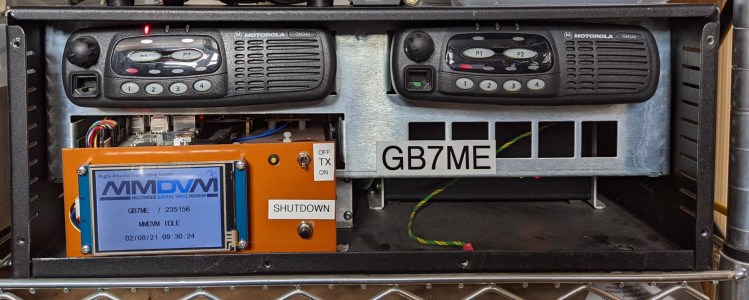
The Mk1 platform comprises two Motorola GM340 radios within a Eurobase chassis. The controller is an MMDVM modem using an Arduino Due with Atmel AT91SAM3X8E. This and the MMDVM host on a Raspberry Pi are built from source. The Raspberry Pi also does some additional tasks such as thermal monitoring & recording network latency.

